
Current
The Rhinoceros and the Unicorn
- Period
- Saturday, March 21, 2026 ~ Sunday, July 19, 2026
- Venue
- Gallery 2 & 3, Cinema Eulsuk, Busan Museum of Contemporary Art(B1)
- Artists
- Lee Jungyoon, Changzak.A, Chu Mirim, Ayaka Fukano, Balint Zsako, Jumaadi, Magoz
- Media
- Paintings, drawings, video, interactive art
- Curator
- Sunghee Kim, Youngmin Choi
- 내용
-
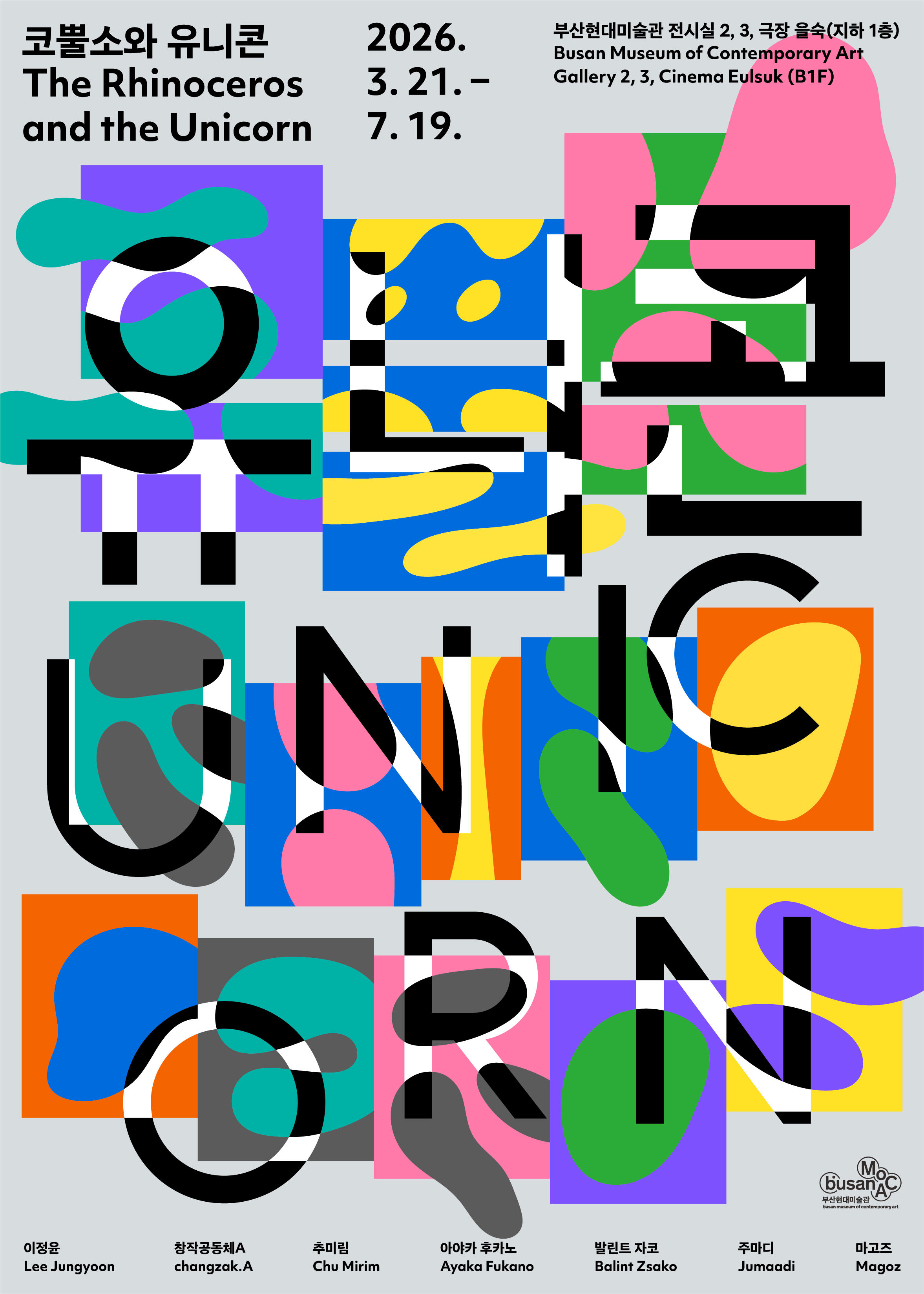
The Rhinoceros and the Unicorn is an exhibition that reconsiders, through the sensibility of the present, the order of the world long promised by old stories. “And they lived happily ever after” has long functioned as a familiar form of reassurance and resolution. Yet the reality we inhabit now rarely comes to a close in such a way. Judgments often diverge, outcomes appear where they are least expected, and the question of what is true remains, more often than not, an unfinished task. It is from this gap that the exhibition begins.
The title The Rhinoceros and the Unicorn may suggest a division between reality and fantasy, but the exhibition does not simply follow that distinction. The reality before our eyes is often more unstable, while beings from fantasy sometimes remain with greater clarity. Within that dissonance, the exhibition shows how the order once promised by old narratives and the uncertainty of contemporary feeling can be placed side by side.
The exhibition unfolds in an omnibus format, with the galleries conceived as a single wordless picture book. Rather than following explanatory texts, visitors move from scene to scene, encountering each story in their own way through the arrangement of images, their sequence, their intervals, and their atmosphere. Familiar narratives are transformed into unfamiliar images, and well-known endings leave behind different emotions and questions. What matters here is not the confirmation of stories we already know, but the chance to experience anew how those stories take shape in the present.
This exhibition brings together works by Lee Jungyoon, changzak A, Chu Mirim, Ayaka Fukano, Balint Zsako, Jumaadi, and Magoz. Drawing on folktales from different cultural traditions, these works do not converge into a single conclusion, but are instead presented through distinct interpretations and forms. Some expand a single scene into an entire spatial environment. Some disperse one event across multiple voices. Others recast the framework of a familiar narrative through contemporary images and sensibilities. In this way, The Rhinoceros and the Unicorn creates an exhibitionary flow in which different stories and forms remain loosely connected.
In the latter part of the exhibition, this flow continues in the Story Laboratory through books, archival materials, and reading video content. Visitors can encounter artists’ publications created for the exhibition, source narrative materials, and documents related to each artist’s process. Stories voiced once again by a range of contributors from Korea and abroad return the scenes encountered in the galleries in another register. With workshops and screening programs extending this experience further, The Rhinoceros and the Unicorn moves beyond the act of viewing in the gallery alone and opens onto reading, listening, speaking, and making.
For children, The Rhinoceros and the Unicorn offers the pleasure of inventing stories and imagining for themselves. For adults, it offers a chance to look again at narrative structures they may once have believed to be familiar. Even after leaving the exhibition, certain scenes will not easily fade. Things glimpsed and passed by, things not fully grasped, things that remain in the mind despite everything else—these will resurface in the course of everyday life, and the stories will continue there in other forms.
페이지 만족도 조사 및 자료관리 담당부서
자료관리 담당부서
- 학예연구실
- 051-220-7355