News
-
 Busan welcomes the World Heritage Committee
The 48th session of the World Heritage Committee will take place from July 19 to 29 at BEXCO. This marks the first time Korea has hosted the committee since joining the World Heritage Convention in 1988. Around 3,000 cultural heritage officials from member states will be in attendance. The WHC oversees the inscription of properties to the World Heritage List and promotes their conservation. Sites earn designation by having "outstanding universal value." The event comes as Busan seeks UNESCO World Heritage inscription for its "Sites of the Wartime Capital." From government buildings to refugee settlements, the sites are remnants of the city's role sustaining the national government during the Korean War. The committee session, along with the Busan Special Pavilion exhibition, is expected to draw greater international attention to these sites and what they represent.WHC Busan: https://48whcbusan2026.kr/Heritage of Busan as the Wartime CapitalHeritage of Busan as the Wartime Capital comprises 11 sites that commemorate the city's role as the nation's provisional seat of government, refugee haven and center of international cooperation during the Korean War. (Learn more: https://www.busan.go.kr/wartime_capital_eng/)Temporary Presidential Residence Temporary Government Complex Korea Meteorological AdministrationU.S. Embassy / Information ServicePier 1 of Busan Port United Nations Memorial Cemetery Camp HialeahAmi-dong Tombstone Village Uam-dong Cattle Shed Village Yeongdo Bridge Bokbyeongsan Reservoir
Busan welcomes the World Heritage Committee
The 48th session of the World Heritage Committee will take place from July 19 to 29 at BEXCO. This marks the first time Korea has hosted the committee since joining the World Heritage Convention in 1988. Around 3,000 cultural heritage officials from member states will be in attendance. The WHC oversees the inscription of properties to the World Heritage List and promotes their conservation. Sites earn designation by having "outstanding universal value." The event comes as Busan seeks UNESCO World Heritage inscription for its "Sites of the Wartime Capital." From government buildings to refugee settlements, the sites are remnants of the city's role sustaining the national government during the Korean War. The committee session, along with the Busan Special Pavilion exhibition, is expected to draw greater international attention to these sites and what they represent.WHC Busan: https://48whcbusan2026.kr/Heritage of Busan as the Wartime CapitalHeritage of Busan as the Wartime Capital comprises 11 sites that commemorate the city's role as the nation's provisional seat of government, refugee haven and center of international cooperation during the Korean War. (Learn more: https://www.busan.go.kr/wartime_capital_eng/)Temporary Presidential Residence Temporary Government Complex Korea Meteorological AdministrationU.S. Embassy / Information ServicePier 1 of Busan Port United Nations Memorial Cemetery Camp HialeahAmi-dong Tombstone Village Uam-dong Cattle Shed Village Yeongdo Bridge Bokbyeongsan Reservoir
-
 Full steam ahead: Jae-soo Chun takes the helm
Busan Mayor Jae-soo Chun expressed his determination to establish Busan as a new growth hub for Korea. On July 1, Jae-soo Chun took office as Busan's 40th mayor. His administration has two priorities: improving residents' lives and advancing Busan as a maritime capital. His first 100 days will focus on stabilizing the local economy, including fuel cost support for small truck owners, energy vouchers for small business owners and support for delivery and card fees. He will also expand public-sector employment. Looking ahead, the administration will strengthen Busan's maritime economy, anchored by its port and ocean industries. Mayor Chun's mantra has been "the maritime capital of Busan," and the city will leverage its location and infrastructure to draw maritime institutions and companies. As Minister of Oceans and Fisheries, Chun moved the entire ministry to Busan. HMM, the nation's largest container shipping company, will follow and relocate its headquarters to the city. The administration also hopes to attract core public institutions such as the Korea Maritime Transportation Safety Authority and the Korea Marine Environment Management Corporation, and to anchor a new Southeastern Investment Corporation - a state-backed fund expected to inject billions of dollars into the regional economy. Officials also expect to open the Busan Maritime International and Commercial Court in 2028 to handle maritime civil and administrative cases as well as international commercial ones. The court would help Korean firms save millions of dollars a year they now spend in extra legal fees settling maritime disputes abroad. By linking shipping, logistics and maritime finance and law, the city aims to build an integrated ecosystem poised to benefit from emerging Arctic shipping routes and to become a leading maritime hub in Northeast Asia. Artificial intelligence and tourism will also shape Busan's growth. The city plans to turn western Busan into a hub for AI-driven manufacturing, lifting local industries through advanced technology. Tourism, meanwhile, will expand beyond the usual hotspots into the historic city center and western Busan. By drawing visitors across a wider area and encouraging longer stays, the city hopes to spread tourism's benefits more evenly. That push serves a larger goal: strengthening Busan's standing as a global city. By developing its maritime industries, tourism and technology sectors, Mayor Chun aims to attract more foreign investment, deepen international exchange and foster an environment where visitors and foreign residents alike feel welcome. Alongside its economic agenda, the administration is working to govern more closely with residents. The city plans to reflect citizens' views in its policies and budgets, and to favor measures that produce changes people can feel in daily life. Creating a city where young people can build their futures is another priority. Busan will widen support for employment, entrepreneurship, housing and culture. Branded the "Youth New Deal," the plan would see the city hire young people directly and place them with local firms in maritime shipping and renewable energy. The aim is straightforward: an environment where talented people put down roots and businesses thrive.
Full steam ahead: Jae-soo Chun takes the helm
Busan Mayor Jae-soo Chun expressed his determination to establish Busan as a new growth hub for Korea. On July 1, Jae-soo Chun took office as Busan's 40th mayor. His administration has two priorities: improving residents' lives and advancing Busan as a maritime capital. His first 100 days will focus on stabilizing the local economy, including fuel cost support for small truck owners, energy vouchers for small business owners and support for delivery and card fees. He will also expand public-sector employment. Looking ahead, the administration will strengthen Busan's maritime economy, anchored by its port and ocean industries. Mayor Chun's mantra has been "the maritime capital of Busan," and the city will leverage its location and infrastructure to draw maritime institutions and companies. As Minister of Oceans and Fisheries, Chun moved the entire ministry to Busan. HMM, the nation's largest container shipping company, will follow and relocate its headquarters to the city. The administration also hopes to attract core public institutions such as the Korea Maritime Transportation Safety Authority and the Korea Marine Environment Management Corporation, and to anchor a new Southeastern Investment Corporation - a state-backed fund expected to inject billions of dollars into the regional economy. Officials also expect to open the Busan Maritime International and Commercial Court in 2028 to handle maritime civil and administrative cases as well as international commercial ones. The court would help Korean firms save millions of dollars a year they now spend in extra legal fees settling maritime disputes abroad. By linking shipping, logistics and maritime finance and law, the city aims to build an integrated ecosystem poised to benefit from emerging Arctic shipping routes and to become a leading maritime hub in Northeast Asia. Artificial intelligence and tourism will also shape Busan's growth. The city plans to turn western Busan into a hub for AI-driven manufacturing, lifting local industries through advanced technology. Tourism, meanwhile, will expand beyond the usual hotspots into the historic city center and western Busan. By drawing visitors across a wider area and encouraging longer stays, the city hopes to spread tourism's benefits more evenly. That push serves a larger goal: strengthening Busan's standing as a global city. By developing its maritime industries, tourism and technology sectors, Mayor Chun aims to attract more foreign investment, deepen international exchange and foster an environment where visitors and foreign residents alike feel welcome. Alongside its economic agenda, the administration is working to govern more closely with residents. The city plans to reflect citizens' views in its policies and budgets, and to favor measures that produce changes people can feel in daily life. Creating a city where young people can build their futures is another priority. Busan will widen support for employment, entrepreneurship, housing and culture. Branded the "Youth New Deal," the plan would see the city hire young people directly and place them with local firms in maritime shipping and renewable energy. The aim is straightforward: an environment where talented people put down roots and businesses thrive.
-
 Busan: The city where K-pop meets the world
Now in its 10th year, the Busan One Asia Festival has evolved from a K-pop concert into a celebration of all things K-culture. The landscape of Busan is changing. Every city leaves a very distinct, personal impression on tourists based on the experiences they have there. So it is with Busan. By wearing an intangible yet powerful layer of the nation's iconic cultural asset, K-Pop, the city shines as a far more fascinating and dynamic destination. At cafes near the concert venue, sparkling conversations about K-pop echo in various languages. Before the show, tourists build anticipation by spending time at Busan's maritime landmarks like Haeundae or Gwangalli beaches. While still soaking up the catharsis of the performance, they can head to bustling downtown areas such as Nampo-dong or Seomyeon to experience the city's lively, sleepless-night culture. Driven by the rise of Korea's unique pop culture, Busan is becoming a resonant place where purpose-driven visitors forge unexpected bonds with the city. Last year, Busan welcomed approximately 3 million international visitors, and it has already crossed the million-visitor threshold in the first quarter of 2026 alone. Building on its widespread acclaim for beautiful beaches, delightful gastronomy, diverse shopping options, and vibrant festivals, Busan has expanded its cultural appeal by integrating K-Pop performances and fandom culture into its tourism landscape. In other words, K-pop serves as a fresh catalyst, inspiring international fans to experience Busan alongside high-energy performances. As these tourists stay for concerts and spend time enjoying Busan's landmarks, shopping opportunities, and local delicacies, they naturally expand their view of the city, embracing a deeply personal connection and lasting memories.The BTS concert after-party in 2022 in BusanCome to see a performance, and stay to experience the city Busan plays host to a major K-pop spectacle, the Busan One Asia Festival. Established in 2016, the BOF has cemented itself as one of the city's most iconic events. By combining a star-studded lineup of performances and immersive themed programs with a wide array of Korean cultural content, this festival has steadily drawn attention from fans around the globe. Alongside the BOF, diverse K-Pop artists have hosted large-scale concerts and global fan events in Busan. This year's highlights feature the BTS WORLD TOUR `ARIRANG', taking place at the Busan Asiad Main Stadium on June 12 and 13. Busan is a seasoned host, having previously welcomed global fans through BTS' special performance in 2022, "Yet To Come in BUSAN." This time, the special bond between BTS and Busan is particularly clear. Since the concert marks the 13th anniversary of BTS돴 debut, it is drawing immense anticipation and attention from fans. Furthermore, it is well known that Busan is the hometown of Jimin and Jungkook, which fosters a unique fan culture as crowds flock to iconic spots associated with the two. As this fan-centered tourism style evolves and spreads across diverse fields, these tourists are vibrantly driving new growth in the local economy. A Busan trip completed outside the performance venue Outside of the concert, visitors explore a variety of spots and experience the city based on their preferences, whether for shopping, culinary exploration, or sightseeing. With this new wave drifting in, it is the golden moment for Busan to showcase its colorful assets, both tangible and intangible. For shopping and urban life, Centum City, Seomyeon, and Nampo-dong are prime destinations for most concertgoers. Centum City serves as a hub of modern facilities, featuring the Shinsegae Centum City Department Store, various cinemas and exhibition centers. To experience the vibrant energy of the local downtown areas, head to Seomyeon and Nampo-dong, where clothing stores, street food stalls, unique cafes and diverse shops line the streets in perfect harmony. Based on which region you travel to, you will witness a completely different side of the city. East Busan appeals to those seeking maritime sports and laid-back ocean city vibes, offering the most striking image of a southern travel destination. Central Busan serves as the axis for vibrant nighttime tourism and a rich gastronomic culture. For those seeking a nature-immersive experience, West Busan offers a beautiful showcase of its ecological charms. "Where are you from?" … The urban conversation created by K-POP As of the first quarter of this year, the number of foreign residents in Busan has reached approximately 70,000. It is now common to hear diverse languages mingle like a natural background soundtrack, particularly in neighborhoods with universities, tourist landmarks, and concert venues. At the centerpiece of this multicultural shift is K-Pop. In Busan, it serves as a universal cultural code that sparks conversation, transcending nationality and language barriers. When passing by concert venues on show days, one can easily find strangers united by their passionate love for a group or music. Busan citizens are by no means excluded from this shift; rather, they are already part of it without even realizing it. During concert and festival seasons, when the city is bustling with new visitors, many locals naturally guide foreign tourists or help them take nice photos. This demonstrates that K-Pop has evolved beyond a mere consumer product, functioning instead as a cultural mediator that fosters new social exchanges within the city. Aanshi Sharma is an international a student from India. In 2017, after listening to BTS for the first time, Ms. Sharma studied Hangeul to understand the lyrics. She dreamed of living in Korea. "It was the music that ignited my interest in Korea," she said, "and that eventually led me to study here in Busan." Dreams do come true. She is excited to watch BTS in Busan, her home since 2024.※Full interview: Click to view
Busan: The city where K-pop meets the world
Now in its 10th year, the Busan One Asia Festival has evolved from a K-pop concert into a celebration of all things K-culture. The landscape of Busan is changing. Every city leaves a very distinct, personal impression on tourists based on the experiences they have there. So it is with Busan. By wearing an intangible yet powerful layer of the nation's iconic cultural asset, K-Pop, the city shines as a far more fascinating and dynamic destination. At cafes near the concert venue, sparkling conversations about K-pop echo in various languages. Before the show, tourists build anticipation by spending time at Busan's maritime landmarks like Haeundae or Gwangalli beaches. While still soaking up the catharsis of the performance, they can head to bustling downtown areas such as Nampo-dong or Seomyeon to experience the city's lively, sleepless-night culture. Driven by the rise of Korea's unique pop culture, Busan is becoming a resonant place where purpose-driven visitors forge unexpected bonds with the city. Last year, Busan welcomed approximately 3 million international visitors, and it has already crossed the million-visitor threshold in the first quarter of 2026 alone. Building on its widespread acclaim for beautiful beaches, delightful gastronomy, diverse shopping options, and vibrant festivals, Busan has expanded its cultural appeal by integrating K-Pop performances and fandom culture into its tourism landscape. In other words, K-pop serves as a fresh catalyst, inspiring international fans to experience Busan alongside high-energy performances. As these tourists stay for concerts and spend time enjoying Busan's landmarks, shopping opportunities, and local delicacies, they naturally expand their view of the city, embracing a deeply personal connection and lasting memories.The BTS concert after-party in 2022 in BusanCome to see a performance, and stay to experience the city Busan plays host to a major K-pop spectacle, the Busan One Asia Festival. Established in 2016, the BOF has cemented itself as one of the city's most iconic events. By combining a star-studded lineup of performances and immersive themed programs with a wide array of Korean cultural content, this festival has steadily drawn attention from fans around the globe. Alongside the BOF, diverse K-Pop artists have hosted large-scale concerts and global fan events in Busan. This year's highlights feature the BTS WORLD TOUR `ARIRANG', taking place at the Busan Asiad Main Stadium on June 12 and 13. Busan is a seasoned host, having previously welcomed global fans through BTS' special performance in 2022, "Yet To Come in BUSAN." This time, the special bond between BTS and Busan is particularly clear. Since the concert marks the 13th anniversary of BTS돴 debut, it is drawing immense anticipation and attention from fans. Furthermore, it is well known that Busan is the hometown of Jimin and Jungkook, which fosters a unique fan culture as crowds flock to iconic spots associated with the two. As this fan-centered tourism style evolves and spreads across diverse fields, these tourists are vibrantly driving new growth in the local economy. A Busan trip completed outside the performance venue Outside of the concert, visitors explore a variety of spots and experience the city based on their preferences, whether for shopping, culinary exploration, or sightseeing. With this new wave drifting in, it is the golden moment for Busan to showcase its colorful assets, both tangible and intangible. For shopping and urban life, Centum City, Seomyeon, and Nampo-dong are prime destinations for most concertgoers. Centum City serves as a hub of modern facilities, featuring the Shinsegae Centum City Department Store, various cinemas and exhibition centers. To experience the vibrant energy of the local downtown areas, head to Seomyeon and Nampo-dong, where clothing stores, street food stalls, unique cafes and diverse shops line the streets in perfect harmony. Based on which region you travel to, you will witness a completely different side of the city. East Busan appeals to those seeking maritime sports and laid-back ocean city vibes, offering the most striking image of a southern travel destination. Central Busan serves as the axis for vibrant nighttime tourism and a rich gastronomic culture. For those seeking a nature-immersive experience, West Busan offers a beautiful showcase of its ecological charms. "Where are you from?" … The urban conversation created by K-POP As of the first quarter of this year, the number of foreign residents in Busan has reached approximately 70,000. It is now common to hear diverse languages mingle like a natural background soundtrack, particularly in neighborhoods with universities, tourist landmarks, and concert venues. At the centerpiece of this multicultural shift is K-Pop. In Busan, it serves as a universal cultural code that sparks conversation, transcending nationality and language barriers. When passing by concert venues on show days, one can easily find strangers united by their passionate love for a group or music. Busan citizens are by no means excluded from this shift; rather, they are already part of it without even realizing it. During concert and festival seasons, when the city is bustling with new visitors, many locals naturally guide foreign tourists or help them take nice photos. This demonstrates that K-Pop has evolved beyond a mere consumer product, functioning instead as a cultural mediator that fosters new social exchanges within the city. Aanshi Sharma is an international a student from India. In 2017, after listening to BTS for the first time, Ms. Sharma studied Hangeul to understand the lyrics. She dreamed of living in Korea. "It was the music that ignited my interest in Korea," she said, "and that eventually led me to study here in Busan." Dreams do come true. She is excited to watch BTS in Busan, her home since 2024.※Full interview: Click to view
Enjoy Busan
-
 Paddle, party, repeat: SUP FESTA takes over North Port
The 2026 North Port SUP FESTA rides into Busan from July 31 to Aug. 9, bringing watersports, live music and cultural programs to North Port Waterfront Park and the North Port Landmark Site.This year's festival is bigger than ever, marking the 150th anniversary of Busan Port's opening and the Ministry of Oceans and Fisheries' move to the city. Events run daily from 4 to 9 p.m. across three themed zones: the Maritime Leisure Zone, the Healing Culture & Performance Zone, and the Food, Exhibition & Market Zone.The Maritime Leisure Zone puts visitors right in the action, with sunset and nighttime views over North Port as the backdrop. Beyond the festival's signature stand-up paddleboarding, guests can hop aboard moon-shaped and UFO boats, or try kayaking and hydrobikes. Pre-registration is required on the festival's official website.The Healing Culture & Performance Zone keeps Busan's midsummer nights lively. A DJ set kicks off every evening at 7 p.m. (except Aug. 1), while the four-night Night of the North Port series brings indie bands, jazz and “fusion gugak,” a modern take on traditional Korean music, to the stage. Buskers at the park's stepped square add to the waterfront buzz.Over at the North Port Landmark Site, the Food, Exhibition & Market Zone serves up food trucks, a craft market and hands-on fun, including keyring and keycap customization workshops, games and photo zones.A few extras round out the lineup. The Luminous Run, an evening run through the park, takes place Aug. 1 and 8. The lawn square hosts the HeumSUP Show, a splashy performance built to cool down hot summer nights. A meditation program arrives Aug. 1, and the North Port Open Cinema screens the Irish musical film "Once" on Aug. 7, set against the glittering nighttime skyline of North Port.Full schedules and registration are available on the festival's official website.※ North Port SUP Festa, July 31 to Aug. 9◎ North Port Waterfront Park: 164 Yi Sun-shin-daero, Dong-gu◎ Google Maps: Click ◎ Website: Click <Today's Vocabulary - 오늘의 단어>anniversary: 기념일 run: 운영하다 meditation: 명상Editor: Song SoomiCopy Editors: Ryu Hyoseung, Anton J. Mapoy
Paddle, party, repeat: SUP FESTA takes over North Port
The 2026 North Port SUP FESTA rides into Busan from July 31 to Aug. 9, bringing watersports, live music and cultural programs to North Port Waterfront Park and the North Port Landmark Site.This year's festival is bigger than ever, marking the 150th anniversary of Busan Port's opening and the Ministry of Oceans and Fisheries' move to the city. Events run daily from 4 to 9 p.m. across three themed zones: the Maritime Leisure Zone, the Healing Culture & Performance Zone, and the Food, Exhibition & Market Zone.The Maritime Leisure Zone puts visitors right in the action, with sunset and nighttime views over North Port as the backdrop. Beyond the festival's signature stand-up paddleboarding, guests can hop aboard moon-shaped and UFO boats, or try kayaking and hydrobikes. Pre-registration is required on the festival's official website.The Healing Culture & Performance Zone keeps Busan's midsummer nights lively. A DJ set kicks off every evening at 7 p.m. (except Aug. 1), while the four-night Night of the North Port series brings indie bands, jazz and “fusion gugak,” a modern take on traditional Korean music, to the stage. Buskers at the park's stepped square add to the waterfront buzz.Over at the North Port Landmark Site, the Food, Exhibition & Market Zone serves up food trucks, a craft market and hands-on fun, including keyring and keycap customization workshops, games and photo zones.A few extras round out the lineup. The Luminous Run, an evening run through the park, takes place Aug. 1 and 8. The lawn square hosts the HeumSUP Show, a splashy performance built to cool down hot summer nights. A meditation program arrives Aug. 1, and the North Port Open Cinema screens the Irish musical film "Once" on Aug. 7, set against the glittering nighttime skyline of North Port.Full schedules and registration are available on the festival's official website.※ North Port SUP Festa, July 31 to Aug. 9◎ North Port Waterfront Park: 164 Yi Sun-shin-daero, Dong-gu◎ Google Maps: Click ◎ Website: Click <Today's Vocabulary - 오늘의 단어>anniversary: 기념일 run: 운영하다 meditation: 명상Editor: Song SoomiCopy Editors: Ryu Hyoseung, Anton J. Mapoy
-
 Life's a beach in Busan
source: Busan Tourism Archive🥽 Ilgwang BeachSlow down and savor a peaceful walk by the seaIlgwang Beach offers a peaceful escape from the bustle of the city. Visitors can unwind with a stroll along the coastal trails and soak in the soothing scenery. source: Busan Tourism Archive🌊 Imnang BeachA peaceful retreat on Busan's eastern coastTucked away on the eastern edge of Busan, Imnang Beach reveals a quieter side of the city's coastline. Its tranquil atmosphere and picturesque seaside scenery make it an ideal place to slow down and unwind. Early risers can often spot anglers casting their lines against the calm morning sea, adding to the beach's laid-back charm.<Today's Vocabulary - 오늘의 단어>escape: 도피 unwind: 긴장을 풀다 stroll: 산책 soak: 흠뻑 젖다 ideal: 이상적인 angler: 낚시꾼Editor: Song SoomiCopy Editors: Ryu Hyoseung, Anton J. Mapoy
Life's a beach in Busan
source: Busan Tourism Archive🥽 Ilgwang BeachSlow down and savor a peaceful walk by the seaIlgwang Beach offers a peaceful escape from the bustle of the city. Visitors can unwind with a stroll along the coastal trails and soak in the soothing scenery. source: Busan Tourism Archive🌊 Imnang BeachA peaceful retreat on Busan's eastern coastTucked away on the eastern edge of Busan, Imnang Beach reveals a quieter side of the city's coastline. Its tranquil atmosphere and picturesque seaside scenery make it an ideal place to slow down and unwind. Early risers can often spot anglers casting their lines against the calm morning sea, adding to the beach's laid-back charm.<Today's Vocabulary - 오늘의 단어>escape: 도피 unwind: 긴장을 풀다 stroll: 산책 soak: 흠뻑 젖다 ideal: 이상적인 angler: 낚시꾼Editor: Song SoomiCopy Editors: Ryu Hyoseung, Anton J. Mapoy
-
 What to do this weekend: Street Festa at Gwangbok-ro
The 2026 Starry Night in Busan: Night Festa returns for the second half of 2026. The city’s signature nighttime tourism program promises fun experiences across the city.The program opens with the Street Festa on July 25 from 5 to 8 p.m at Gwangbok-ro (Gwangbok Street) in Nampo-dong. The event will feature a parade and live music at three different spots. Festivalgoers can also enjoy hands-on activities like making dalgona candy, playing traditional games and shopping at a crafts market.The rest of the year will feature the Balcony Music Show, a series of live performances presented from the second-floor balcony of the Busan Brand Shop. Visitors can expect a mix of genres, including K-pop, traditional Korean music and jazz. 2026 Starry Night in Busan: Night Festa Events-Night Walk: (Aug. 29-30): On Aug. 29 and 30, take a waterfront stroll from APEC Naru Park to Millak-dong while enjoying Busan's illuminated waterfront scenery. -Night Music Campnic: On Fridays and Saturdays from Sept. 4 to 19, visit Dadaepo Beach Park to enjoy an outdoor picnic and live music.-Night Market: Every Thursday to Sunday from Sept. 26 to Oct 18, head to Hamyeong Eco Park to enjoy traditional Korean liquor, self-cooking zones, food stalls and interactive experiences for an easy night out.※2026 Starry Night in Busan: Night Festa◎Visit Busan: Click ◎Instagram: @starry_night_busan.kr<Today's Vocabulary - 오늘의 단어>second half: 하반기 expect: 예상하다 illumitate: 불을 밝히다 interactive: 상호적인Editor: Song SoomiCopy Editors: Ryu Hyoseung, Anton J. Mapoy
What to do this weekend: Street Festa at Gwangbok-ro
The 2026 Starry Night in Busan: Night Festa returns for the second half of 2026. The city’s signature nighttime tourism program promises fun experiences across the city.The program opens with the Street Festa on July 25 from 5 to 8 p.m at Gwangbok-ro (Gwangbok Street) in Nampo-dong. The event will feature a parade and live music at three different spots. Festivalgoers can also enjoy hands-on activities like making dalgona candy, playing traditional games and shopping at a crafts market.The rest of the year will feature the Balcony Music Show, a series of live performances presented from the second-floor balcony of the Busan Brand Shop. Visitors can expect a mix of genres, including K-pop, traditional Korean music and jazz. 2026 Starry Night in Busan: Night Festa Events-Night Walk: (Aug. 29-30): On Aug. 29 and 30, take a waterfront stroll from APEC Naru Park to Millak-dong while enjoying Busan's illuminated waterfront scenery. -Night Music Campnic: On Fridays and Saturdays from Sept. 4 to 19, visit Dadaepo Beach Park to enjoy an outdoor picnic and live music.-Night Market: Every Thursday to Sunday from Sept. 26 to Oct 18, head to Hamyeong Eco Park to enjoy traditional Korean liquor, self-cooking zones, food stalls and interactive experiences for an easy night out.※2026 Starry Night in Busan: Night Festa◎Visit Busan: Click ◎Instagram: @starry_night_busan.kr<Today's Vocabulary - 오늘의 단어>second half: 하반기 expect: 예상하다 illumitate: 불을 밝히다 interactive: 상호적인Editor: Song SoomiCopy Editors: Ryu Hyoseung, Anton J. Mapoy
Food
-
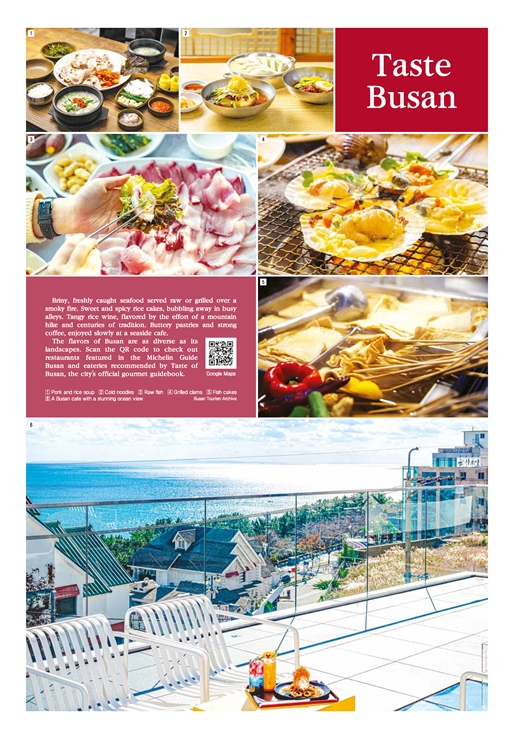 Taste Busan
Briny, freshly caught seafood served raw or grilled over a smoky fire. Sweet and spicy rice cakes, bubbling away in busy alleys. Tangy rice wine, flavored by the effort of a mountain hike and centuries of tradition. Buttery pastries and strong coffee, enjoyed slowly at a seaside cafe. The flavors of Busan are as diverse as its landscapes. Check out restaurants featured in the Michelin Guide Busan and eateries recommended by Taste of Busan, the city's official gourmet guidebook.
Taste Busan
Briny, freshly caught seafood served raw or grilled over a smoky fire. Sweet and spicy rice cakes, bubbling away in busy alleys. Tangy rice wine, flavored by the effort of a mountain hike and centuries of tradition. Buttery pastries and strong coffee, enjoyed slowly at a seaside cafe. The flavors of Busan are as diverse as its landscapes. Check out restaurants featured in the Michelin Guide Busan and eateries recommended by Taste of Busan, the city's official gourmet guidebook.
-
 A new star joins the show
Busan is now home to four Michelin-starred restaurants, marking a new era for local gastronomy. Le DORER, a contemporary Korean fine-dining establishment, recently earned one star in the 2026 Michelin Guide Seoul and Busan, released on March 5. The restaurant joins one-starred restaurants Mori, Palate and Fiotto atop the dining landscape. Furthermore, Busan welcomed a diverse array of eateries officially selected for the Michelin Guide. The latest restaurants to join the prestigious list are introduced below. ■ Le DORER 르도헤 (Michelin One Star) A young yet remarkably accomplished head chef showcases an astonishing interpretation of Korean cuisine through sophisticated techniques. This chef from Busan offers a delightful exploration of the region's seasonal ingredients, filtered through a modern perspective. While starting its journey as a Korean restaurant, Le DORER has evolved to redefine the genre's essence with contemporary flair. Infused with French and Japanese techniques, each course offers an expansive, exciting experience, presenting familiar ingredients with bold and unexpected twists. *Address: 2F, 37 Marine city 3-ro, Haeundae-gu*Hours: Lunch 12-2:30 p.m. / Dinner 5-10 p.m. Closed on Mondays and Tuesdays.*Menu: Lunch Course 120,000 won / Dinner Course 210,000 won ■ Moemiljip 뫼밀집 ( Bib Gourmand) Its signature noodles, made in-house entirely from Korean buckwheat, instantly awaken your senses to what authentic texture and taste truly feel like. The unique chewiness, combined with buckwheat's deep, earthy flavor, is remarkably distinctive. These noodles pair perfectly with Moemiljip's slices of boiled pork - bouncy, collagen-rich and deeply satisfying.*Address: 2F, Orange Plaza, 23 Marine City 3-ro, Haeundae-gu*Hours: Lunch 11:30 a.m. - 3:30 p.m. Dinner 5-8:30 p.m. (Last orders 3, 8 p.m.). Closed on Mondays.*Menu: Buckwheat Noodles with Perilla Oil 17,000 won. ■ Jin Dweji Gomtang 진돼지곰탕 Established in 2024, this eatery went viral almost immediately, drawing a younger crowd with its clear, savory pork broth. Dishes are made with Berkshire K black pigs from Jirisan; the prized breed is renowned for producing high-quality, heavily marbled and tender meat. Although Busan is traditionally known for Dwaeji gukbap (pork soup with rice), Jin Dweji Gomtang carves out its own lane with a different approach to similar ingredients: The broth is made with meat rather than bones, resulting in a clean, light soup that keeps diners craving another spoonful. The restaurant's main location is near Gwangalli Beach, and another branch recently opened near Busan Station.*Address: 2F, 4 Gwanganhaebyeon-ro 284 beon-gil, Suyeong-gu*Hours: Open daily from 9:30 a.m. to 9 p.m. (Last order 8:40 p.m.)*Menu: Dweji Gomtang 13,000 won ■ Unaju 우나쥬 Following the original recipes of Shirakawa, a grilled-eel-specialist restaurant in Nagoya founded in 1948, Unaju's grilled eel is nothing short of artistry. With meticulous technique and patience, each fresh eel is double-grilled to perfection, yielding a crispy exterior that gives way to a delightfully springy, succulent interior.*Address: 39 Cheongsapo-ro 67beon-gil, Haeundae-gu*Hours: Lunch 11 a.m. to 3 p.m. Dinner 5-10 p.m. (Last order 8:30 p.m.)*Signature: Hitsumabushi (Nagoya-style grilled eel) 39,000 won ■ Iwa 이와 Holding a patent for its specialized fish-ageing technique, Iwa's chef is a true master of the unique characteristics and conditions of every catch. By bringing out the absolute best qualities in each fish, the chef presents meticulously aged sashimi that reveals a next-level texture and profound depth of flavor. At Iwa, guests can indulge in exquisite omakase courses at remarkably reasonable prices. *Address: 2F, 13 Haeundaehaebyeon-ro 209 beon-gil, Haeundae-gu*Hours: Open from 12 to 10 p.m. Closed on Sundays.*Menu: Omakase (Prices may vary) ■ Pyeongsanok 평산옥 Pyeongsanok, a local institution operated by the same family over four generations, specializes in "suyuk," tender slices of boiled pork, and noodles. The restaurant has been serving guests for over a century, proving that simple food done well is always in demand.*Address: 26, Choryangjung-ro, Dong-gu*Hours: Open from 11 a.m. to 8 p.m. Closed on Sundays.*Menu: Suyuk 10,000 won
A new star joins the show
Busan is now home to four Michelin-starred restaurants, marking a new era for local gastronomy. Le DORER, a contemporary Korean fine-dining establishment, recently earned one star in the 2026 Michelin Guide Seoul and Busan, released on March 5. The restaurant joins one-starred restaurants Mori, Palate and Fiotto atop the dining landscape. Furthermore, Busan welcomed a diverse array of eateries officially selected for the Michelin Guide. The latest restaurants to join the prestigious list are introduced below. ■ Le DORER 르도헤 (Michelin One Star) A young yet remarkably accomplished head chef showcases an astonishing interpretation of Korean cuisine through sophisticated techniques. This chef from Busan offers a delightful exploration of the region's seasonal ingredients, filtered through a modern perspective. While starting its journey as a Korean restaurant, Le DORER has evolved to redefine the genre's essence with contemporary flair. Infused with French and Japanese techniques, each course offers an expansive, exciting experience, presenting familiar ingredients with bold and unexpected twists. *Address: 2F, 37 Marine city 3-ro, Haeundae-gu*Hours: Lunch 12-2:30 p.m. / Dinner 5-10 p.m. Closed on Mondays and Tuesdays.*Menu: Lunch Course 120,000 won / Dinner Course 210,000 won ■ Moemiljip 뫼밀집 ( Bib Gourmand) Its signature noodles, made in-house entirely from Korean buckwheat, instantly awaken your senses to what authentic texture and taste truly feel like. The unique chewiness, combined with buckwheat's deep, earthy flavor, is remarkably distinctive. These noodles pair perfectly with Moemiljip's slices of boiled pork - bouncy, collagen-rich and deeply satisfying.*Address: 2F, Orange Plaza, 23 Marine City 3-ro, Haeundae-gu*Hours: Lunch 11:30 a.m. - 3:30 p.m. Dinner 5-8:30 p.m. (Last orders 3, 8 p.m.). Closed on Mondays.*Menu: Buckwheat Noodles with Perilla Oil 17,000 won. ■ Jin Dweji Gomtang 진돼지곰탕 Established in 2024, this eatery went viral almost immediately, drawing a younger crowd with its clear, savory pork broth. Dishes are made with Berkshire K black pigs from Jirisan; the prized breed is renowned for producing high-quality, heavily marbled and tender meat. Although Busan is traditionally known for Dwaeji gukbap (pork soup with rice), Jin Dweji Gomtang carves out its own lane with a different approach to similar ingredients: The broth is made with meat rather than bones, resulting in a clean, light soup that keeps diners craving another spoonful. The restaurant's main location is near Gwangalli Beach, and another branch recently opened near Busan Station.*Address: 2F, 4 Gwanganhaebyeon-ro 284 beon-gil, Suyeong-gu*Hours: Open daily from 9:30 a.m. to 9 p.m. (Last order 8:40 p.m.)*Menu: Dweji Gomtang 13,000 won ■ Unaju 우나쥬 Following the original recipes of Shirakawa, a grilled-eel-specialist restaurant in Nagoya founded in 1948, Unaju's grilled eel is nothing short of artistry. With meticulous technique and patience, each fresh eel is double-grilled to perfection, yielding a crispy exterior that gives way to a delightfully springy, succulent interior.*Address: 39 Cheongsapo-ro 67beon-gil, Haeundae-gu*Hours: Lunch 11 a.m. to 3 p.m. Dinner 5-10 p.m. (Last order 8:30 p.m.)*Signature: Hitsumabushi (Nagoya-style grilled eel) 39,000 won ■ Iwa 이와 Holding a patent for its specialized fish-ageing technique, Iwa's chef is a true master of the unique characteristics and conditions of every catch. By bringing out the absolute best qualities in each fish, the chef presents meticulously aged sashimi that reveals a next-level texture and profound depth of flavor. At Iwa, guests can indulge in exquisite omakase courses at remarkably reasonable prices. *Address: 2F, 13 Haeundaehaebyeon-ro 209 beon-gil, Haeundae-gu*Hours: Open from 12 to 10 p.m. Closed on Sundays.*Menu: Omakase (Prices may vary) ■ Pyeongsanok 평산옥 Pyeongsanok, a local institution operated by the same family over four generations, specializes in "suyuk," tender slices of boiled pork, and noodles. The restaurant has been serving guests for over a century, proving that simple food done well is always in demand.*Address: 26, Choryangjung-ro, Dong-gu*Hours: Open from 11 a.m. to 8 p.m. Closed on Sundays.*Menu: Suyuk 10,000 won
-
.jpg&fileext=jpg&filetype=image/jpeg&filesize=73169) A new star joins the show
Busan’s gourmet scene is blooming like a meticulously curated garden. The city is now home to four Michelin-starred restaurants, marking a new era for local gastronomy. Le DORER, a contemporary Korean fine-dining establishment, recently earned one star in the 2026 Michelin Guide Seoul and Busan, released on March 5. The restaurant joins Mori, Palate and Fiotto – all boasting one star – atop Busan’s dining landscape.Furthermore, Busan welcomed a diverse array of eateries officially selected for the Michelin Guide. The list features Jin Dweji Gomtang, renowned for its deep, savory pork broth, and Moemiljip, which showcases the unique texture of 100% Korean buckwheat noodles. Other notable entries include Pyeongsanok, boasting a century of heritage with its signature slices of boiled pork; Unaju, famous for its grilled eel served over rice; and Iwa, acclaimed for its distinctive fish-ageing techniques. source: Michelin Guide⭐ Le DORER 르도헤 (Michelin One Star)A young yet remarkably accomplished head chef showcases an astonishing interpretation of Korean cuisine through sophisticated techniques. This chef from Busan offers a delightful exploration of the region’s seasonal ingredients, filtered through a modern perspective. While starting its journey as a Korean restaurant, Le DORER has evolved to redefine the genre’s essence with contemporary flair. Infused with French and Japanese techniques, each course offers an expansive, exciting experience, presenting familiar ingredients with bold and unexpected twists. Address: 2F, 37 Marine city 3-ro, Haeundae-guNaver Map: Click Hours: Lunch 12-2:30 p.m. / Dinner 5-10 p.m. Closed on Mondays and Tuesdays.Menu: Lunch Course 120,000 won / Dinner Course 210,000 wonsource: Michelin Guide🍜 Moemiljip 뫼밀집 (Bib Gourmand)Its signature noodles, made in-house entirely from Korean buckwheat, instantly awaken your senses to what authentic texture and taste truly feel like. The unique chewiness, combined with buckwheat’s deep, earthy flavor, is remarkably distinctive. These noodles pair perfectly with Moemiljip’s slices of boiled pork—bouncy, collagen-rich and deeply satisfying.Address: 2F, Orange Plaza, 23 Marine City 3-ro, Haeundae-guNaver Map: Click Hours: Lunch 11:30 a.m. – 3:30 p.m. Dinner 5-8:30 p.m. (Last orders 3, 8 p.m.). Closed on Mondays.Menu: Buckwheat Noodles with Perilla Oil 17,000 won.source: Michelin Guide🥣 Jin Dweji Gomtang 진돼지곰탕 Established in 2024, this eatery went viral almost immediately, drawing a younger crowd with its clear, savory pork broth. Dishes are made with Berkshire K black pigs from Jirisan; the prized breed is renowned for producing high-quality, heavily marbled and tender meat.Although Busan is traditionally known for Dwaeji-gukbap (Pork soup with rice), Jin Dweji Gomtang carves out its own lane with a different approach to similar ingredients: The broth is built around meat rather than bones, resulting in a clean, light soup that keeps diners craving another spoonful.The restaurant’s main location is near Gwangalli Beach, and another branch recently opened near Busan Station.Address: 2F, 4 Gwanganhaebyeon-ro 284 beon-gil, Suyeong-guNaver Map (Suyeong): Click Naver Map (Busan Station): Click Hours: Open daily from 9:30 a.m. to 9 p.m. (Last order 8:40 p.m.)Menu: Dweji Gomtang 13,000 won source: Michelin Guide🍱 Unaju 우나쥬Following the original recipes of Shirakawa, a grilled-eel-specialist restaurant in Nagoya founded in 1948, Unaju’s grilled eel is nothing short of artistry. With meticulous technique and patience, each fresh eel is double-grilled to perfection, yielding a crispy exterior that gives way to a delightfully springy, succulent interior.Address: 39 Cheongsapo-ro 67beon-gil, Haeundae-guNaver Map: Click Hours: Lunch 11 a.m. to 3 p.m. Dinner 5-10 p.m. (Last order 8:30 p.m.)Signature: Hitsumabushi (Nagoya-style grilled eel) 39,000 wonsource: Michelin Guide🦐 Iwa 이와Holding a patent for its specialized fish-ageing technique, Iwa’s chef is a true master of the unique characteristics and conditions of every catch. By bringing out the absolute best qualities in each fish, the chef presents meticulously aged sashimi that reveals a next-level texture and profound depth of flavor. At Iwa, guests can indulge in exquisite omakase-style courses at remarkably reasonable prices. Address: 2F, 13 Haeundaehaebyeon-ro 209 beon-gil, Haeundae-guNaver Map: Click Hours: Open from 12 to 10 p.m. Closed on Sundays.Menu: Omakase (Prices may vary)source: Busan City's official Naver Blog🥩 Pyeongsanok 평산옥Pyeongsanok, a local institution operated by the same family over four generations, specializes in “suyuk,” tender slices of boiled pork, and noodles. The restaurant has been serving guests for over a century, proving that simple food done well is always in demand. Address: 26, Choryangjung-ro, Dong-guNaver Map: Click Hours: Open from 11 a.m. to 8 p.m. Closed on Sundays.Menu: Suyuk 10,000 won※Restaurant information may be subject to change.<Today's Vocabulary - 오늘의 단어>astonishing: 놀라운 perspective: 관점 twists: 반전 buckwheat: 메밀 chewiness: 씹히는 맛 broth: 육수 branch: 지점 exquisite: 정교한 Editor: Song SoomiCopy Editors: Ryu Hyoseung, Anton J. Mapoy
A new star joins the show
Busan’s gourmet scene is blooming like a meticulously curated garden. The city is now home to four Michelin-starred restaurants, marking a new era for local gastronomy. Le DORER, a contemporary Korean fine-dining establishment, recently earned one star in the 2026 Michelin Guide Seoul and Busan, released on March 5. The restaurant joins Mori, Palate and Fiotto – all boasting one star – atop Busan’s dining landscape.Furthermore, Busan welcomed a diverse array of eateries officially selected for the Michelin Guide. The list features Jin Dweji Gomtang, renowned for its deep, savory pork broth, and Moemiljip, which showcases the unique texture of 100% Korean buckwheat noodles. Other notable entries include Pyeongsanok, boasting a century of heritage with its signature slices of boiled pork; Unaju, famous for its grilled eel served over rice; and Iwa, acclaimed for its distinctive fish-ageing techniques. source: Michelin Guide⭐ Le DORER 르도헤 (Michelin One Star)A young yet remarkably accomplished head chef showcases an astonishing interpretation of Korean cuisine through sophisticated techniques. This chef from Busan offers a delightful exploration of the region’s seasonal ingredients, filtered through a modern perspective. While starting its journey as a Korean restaurant, Le DORER has evolved to redefine the genre’s essence with contemporary flair. Infused with French and Japanese techniques, each course offers an expansive, exciting experience, presenting familiar ingredients with bold and unexpected twists. Address: 2F, 37 Marine city 3-ro, Haeundae-guNaver Map: Click Hours: Lunch 12-2:30 p.m. / Dinner 5-10 p.m. Closed on Mondays and Tuesdays.Menu: Lunch Course 120,000 won / Dinner Course 210,000 wonsource: Michelin Guide🍜 Moemiljip 뫼밀집 (Bib Gourmand)Its signature noodles, made in-house entirely from Korean buckwheat, instantly awaken your senses to what authentic texture and taste truly feel like. The unique chewiness, combined with buckwheat’s deep, earthy flavor, is remarkably distinctive. These noodles pair perfectly with Moemiljip’s slices of boiled pork—bouncy, collagen-rich and deeply satisfying.Address: 2F, Orange Plaza, 23 Marine City 3-ro, Haeundae-guNaver Map: Click Hours: Lunch 11:30 a.m. – 3:30 p.m. Dinner 5-8:30 p.m. (Last orders 3, 8 p.m.). Closed on Mondays.Menu: Buckwheat Noodles with Perilla Oil 17,000 won.source: Michelin Guide🥣 Jin Dweji Gomtang 진돼지곰탕 Established in 2024, this eatery went viral almost immediately, drawing a younger crowd with its clear, savory pork broth. Dishes are made with Berkshire K black pigs from Jirisan; the prized breed is renowned for producing high-quality, heavily marbled and tender meat.Although Busan is traditionally known for Dwaeji-gukbap (Pork soup with rice), Jin Dweji Gomtang carves out its own lane with a different approach to similar ingredients: The broth is built around meat rather than bones, resulting in a clean, light soup that keeps diners craving another spoonful.The restaurant’s main location is near Gwangalli Beach, and another branch recently opened near Busan Station.Address: 2F, 4 Gwanganhaebyeon-ro 284 beon-gil, Suyeong-guNaver Map (Suyeong): Click Naver Map (Busan Station): Click Hours: Open daily from 9:30 a.m. to 9 p.m. (Last order 8:40 p.m.)Menu: Dweji Gomtang 13,000 won source: Michelin Guide🍱 Unaju 우나쥬Following the original recipes of Shirakawa, a grilled-eel-specialist restaurant in Nagoya founded in 1948, Unaju’s grilled eel is nothing short of artistry. With meticulous technique and patience, each fresh eel is double-grilled to perfection, yielding a crispy exterior that gives way to a delightfully springy, succulent interior.Address: 39 Cheongsapo-ro 67beon-gil, Haeundae-guNaver Map: Click Hours: Lunch 11 a.m. to 3 p.m. Dinner 5-10 p.m. (Last order 8:30 p.m.)Signature: Hitsumabushi (Nagoya-style grilled eel) 39,000 wonsource: Michelin Guide🦐 Iwa 이와Holding a patent for its specialized fish-ageing technique, Iwa’s chef is a true master of the unique characteristics and conditions of every catch. By bringing out the absolute best qualities in each fish, the chef presents meticulously aged sashimi that reveals a next-level texture and profound depth of flavor. At Iwa, guests can indulge in exquisite omakase-style courses at remarkably reasonable prices. Address: 2F, 13 Haeundaehaebyeon-ro 209 beon-gil, Haeundae-guNaver Map: Click Hours: Open from 12 to 10 p.m. Closed on Sundays.Menu: Omakase (Prices may vary)source: Busan City's official Naver Blog🥩 Pyeongsanok 평산옥Pyeongsanok, a local institution operated by the same family over four generations, specializes in “suyuk,” tender slices of boiled pork, and noodles. The restaurant has been serving guests for over a century, proving that simple food done well is always in demand. Address: 26, Choryangjung-ro, Dong-guNaver Map: Click Hours: Open from 11 a.m. to 8 p.m. Closed on Sundays.Menu: Suyuk 10,000 won※Restaurant information may be subject to change.<Today's Vocabulary - 오늘의 단어>astonishing: 놀라운 perspective: 관점 twists: 반전 buckwheat: 메밀 chewiness: 씹히는 맛 broth: 육수 branch: 지점 exquisite: 정교한 Editor: Song SoomiCopy Editors: Ryu Hyoseung, Anton J. Mapoy
Life
-
 Busan Hangul Institute opens registration for free Korean classes
Want to level up your Korean? The Busan Hangul Institute starts accepting registrations at 10 a.m. Aug. 3 for its free 12-week Korean language program.Run by the Busan Global City Foundation, the courses are designed to help Busan's international students and graduates build the language skills they need for careers in Korea. Classes run Sept. 7 to Nov. 26.Applicants must show a valid Alien Registration Card with a D-2, D-4, D-10 or F-4 visa.A 50,000 won deposit is required to encourage regular attendance — but it's fully refunded once a student completes the course. Students who achieve their target score on the TOPIK exam also receive a full refund of their test fee. The institute has added two new courses this semester: Business Korean and Korean for Job Seekers. Both are built around the vocabulary and phrases used in Korean workplaces and job hunts, giving students practical communication skills for real-world situations.Spots are limited and are available on a first-come, first-served basis. Online registration closes Aug. 28.After applying online, students must also register in person between Aug. 31 and Sept. 4 to lock in their spot.For full class schedules and registration details, visit the BGCF website.※ Busan Hangul Institute free Korean class enrollment, until Aug. 28◎ Notice via Busan Global City Foundation: Click ◎ Registration: Click ◎ Location: National Pension Building, 1000 Jungang-daero, Yeonje-gu• Busan Global City Foundation: 13F• Study Busan Hub: 2F ◎ Google Maps: Click ◎ Inquiries: 1577-7716 (+0 Korean / +1 English / +2 Chinese / +3 Vietnamese / +4 Indonesian / +5 Russian, Uzbek)<Today's Vocabulary - 오늘의 단어>registration: 등록 encourage: 장려하다 attendance: 출석 practical: 실용적인 Editor: Song SoomiCopy Editors: Ryu Hyoseung, Anton J. Mapoy
Busan Hangul Institute opens registration for free Korean classes
Want to level up your Korean? The Busan Hangul Institute starts accepting registrations at 10 a.m. Aug. 3 for its free 12-week Korean language program.Run by the Busan Global City Foundation, the courses are designed to help Busan's international students and graduates build the language skills they need for careers in Korea. Classes run Sept. 7 to Nov. 26.Applicants must show a valid Alien Registration Card with a D-2, D-4, D-10 or F-4 visa.A 50,000 won deposit is required to encourage regular attendance — but it's fully refunded once a student completes the course. Students who achieve their target score on the TOPIK exam also receive a full refund of their test fee. The institute has added two new courses this semester: Business Korean and Korean for Job Seekers. Both are built around the vocabulary and phrases used in Korean workplaces and job hunts, giving students practical communication skills for real-world situations.Spots are limited and are available on a first-come, first-served basis. Online registration closes Aug. 28.After applying online, students must also register in person between Aug. 31 and Sept. 4 to lock in their spot.For full class schedules and registration details, visit the BGCF website.※ Busan Hangul Institute free Korean class enrollment, until Aug. 28◎ Notice via Busan Global City Foundation: Click ◎ Registration: Click ◎ Location: National Pension Building, 1000 Jungang-daero, Yeonje-gu• Busan Global City Foundation: 13F• Study Busan Hub: 2F ◎ Google Maps: Click ◎ Inquiries: 1577-7716 (+0 Korean / +1 English / +2 Chinese / +3 Vietnamese / +4 Indonesian / +5 Russian, Uzbek)<Today's Vocabulary - 오늘의 단어>registration: 등록 encourage: 장려하다 attendance: 출석 practical: 실용적인 Editor: Song SoomiCopy Editors: Ryu Hyoseung, Anton J. Mapoy
-
 Apply now: Busan’s Korean language mentorship program for international students
The Busan Global City Foundation (BGCF) is accepting applications for 30 mentees to join its Korean language mentorship program. Interested individuals should apply by noon on July 27. Applications will be accepted on a first-come, first-served basis.The two-month program, running from August to September, pairs international students with local mentors to improve their Korean proficiency and ease their adjustment to university and daily life in Busan through cultural exchange.After applications close, BGCF will review submissions, confirm eligibility and match mentors with mentees based on their stated preferences and interests. Both parties will be notified of their pairing by email.Mentors and mentees must meet at least once a month. Beyond language practice, the program offers mentees opportunities to explore the city, take part in local events and build friendships with their mentors. Participants who complete the program will receive a certificate from BGCF.Because withdrawing or failing to participate actively affects both the mentor and the program's operations, applicants are asked to confirm their full commitment before applying.Applications can be submitted via the linked Google Form. For more details, visit the BGCF website.※ 2026 Korean Language Learning Support Mentoring Program: Recruitment for Mentees, open until 12 noon on July 27◎ Announcement: Click ◎ Apply as a mentee: Click ◎ Inquiries: yeochimon@bgcf.or.kr / 051-711-6846<Today's Vocabulary - 오늘의 단어>first-come, first-served basis: 선착순 eligibility: 자격 preference: 선호도 affect: 영향을 미치다Editor: Song SoomiCopy Editors: Ryu Hyoseung, Anton J. Mapoy
Apply now: Busan’s Korean language mentorship program for international students
The Busan Global City Foundation (BGCF) is accepting applications for 30 mentees to join its Korean language mentorship program. Interested individuals should apply by noon on July 27. Applications will be accepted on a first-come, first-served basis.The two-month program, running from August to September, pairs international students with local mentors to improve their Korean proficiency and ease their adjustment to university and daily life in Busan through cultural exchange.After applications close, BGCF will review submissions, confirm eligibility and match mentors with mentees based on their stated preferences and interests. Both parties will be notified of their pairing by email.Mentors and mentees must meet at least once a month. Beyond language practice, the program offers mentees opportunities to explore the city, take part in local events and build friendships with their mentors. Participants who complete the program will receive a certificate from BGCF.Because withdrawing or failing to participate actively affects both the mentor and the program's operations, applicants are asked to confirm their full commitment before applying.Applications can be submitted via the linked Google Form. For more details, visit the BGCF website.※ 2026 Korean Language Learning Support Mentoring Program: Recruitment for Mentees, open until 12 noon on July 27◎ Announcement: Click ◎ Apply as a mentee: Click ◎ Inquiries: yeochimon@bgcf.or.kr / 051-711-6846<Today's Vocabulary - 오늘의 단어>first-come, first-served basis: 선착순 eligibility: 자격 preference: 선호도 affect: 영향을 미치다Editor: Song SoomiCopy Editors: Ryu Hyoseung, Anton J. Mapoy
-
 Summer safety guide
source: Busan Tourism ArchiveFrom iconic beaches and maritime activities to colorful festivals, summer is the perfect season to enjoy Busan's vibrant outdoor attractions. While the season often brings bright sunshine and blue skies, it can also bring extreme heat and heavy rain. Keeping a few basic safety tips in mind and carrying a few essential items can help ensure a safe and pleasant summer. ✔ Drink water frequently Drink water regularly, even if you do not feel thirsty, to stay hydrated and protect your health. ✔ Limit outdoor activities during peak hoursHeat and UV exposure are usually strongest between noon and 4 p.m. To avoid heat-related illnesses, stay indoors whenever possible during these hours. ✔ Stay updated on weather conditionsCheck weather forecasts and official alerts for heat waves, heavy rain and storms. Be sure to follow the safety instructions issued for each situation.✔ Stay away from hazardous areasDuring heavy rain or storms, avoid flooded roads, riverbanks and coastal breakwaters, where accidents are more likely.✔ Follow beach safety rulesSwim only in designated areas and always follow lifeguards' and safety personnel's instructions.✔ Seek help immediately if you feel unwellIf you experience symptoms such as dizziness, headaches and fever, move to a cool, shaded area or go indoors and call 119 immediately. 🔍 Are you looking for a cool place?You can find more than 1,800 cooling centers across Busan on the Busan Life Map. The map also provides information on climate shelters, which offer refuge during sudden weather changes. Click <Today's Vocabulary - 오늘의 단어>extreme heat: 폭염 heavy rain: 폭우 instruction: 지침 hazardous: 위험한 dizziness: 어지러움 shelter: 대피소 Editor: Song SoomiCopy Editors: Ryu Hyoseung, Anton J. Mapoy
Summer safety guide
source: Busan Tourism ArchiveFrom iconic beaches and maritime activities to colorful festivals, summer is the perfect season to enjoy Busan's vibrant outdoor attractions. While the season often brings bright sunshine and blue skies, it can also bring extreme heat and heavy rain. Keeping a few basic safety tips in mind and carrying a few essential items can help ensure a safe and pleasant summer. ✔ Drink water frequently Drink water regularly, even if you do not feel thirsty, to stay hydrated and protect your health. ✔ Limit outdoor activities during peak hoursHeat and UV exposure are usually strongest between noon and 4 p.m. To avoid heat-related illnesses, stay indoors whenever possible during these hours. ✔ Stay updated on weather conditionsCheck weather forecasts and official alerts for heat waves, heavy rain and storms. Be sure to follow the safety instructions issued for each situation.✔ Stay away from hazardous areasDuring heavy rain or storms, avoid flooded roads, riverbanks and coastal breakwaters, where accidents are more likely.✔ Follow beach safety rulesSwim only in designated areas and always follow lifeguards' and safety personnel's instructions.✔ Seek help immediately if you feel unwellIf you experience symptoms such as dizziness, headaches and fever, move to a cool, shaded area or go indoors and call 119 immediately. 🔍 Are you looking for a cool place?You can find more than 1,800 cooling centers across Busan on the Busan Life Map. The map also provides information on climate shelters, which offer refuge during sudden weather changes. Click <Today's Vocabulary - 오늘의 단어>extreme heat: 폭염 heavy rain: 폭우 instruction: 지침 hazardous: 위험한 dizziness: 어지러움 shelter: 대피소 Editor: Song SoomiCopy Editors: Ryu Hyoseung, Anton J. Mapoy
Views
-
 What to do in May
May is one of the best months to visit Busan. Festivals take over the city's most iconic settings - beaches, temples, and hillside neighborhoods - turning familiar landmarks into something worth seeing all over again. Lotus lanterns float above temple courtyards, sand sculptures rise along Haeundae's shore and the smell of fresh coffee drifts through the streets. Whether you're drawn by the food, the art or simply the energy of a city in full spring bloom, May is an exciting time to be in Busan.■ Busan Lotus Lantern Festival 부산연등회◎Date: May 1 to 17◎Location: Song Sanghyeon Square, Busan Citizens Park In celebration of Buddha's birthday on May 24, various lotus lanterns will color Song Sanghyeon Square with an enchanting display. Wishing for good fortune, citizens can enjoy a delightful stroll among delicate lights featuring unique designs that capture the eye. On May 16, a street parade will take place at Busan Citizens Park, inviting people to hold lanterns and march together. ■ Global Yeong-do Coffee Festival 영도 커피페스티벌◎Date: May 15 to 17◎Location: Amir Park This vibrant festival has returned to brew Yeong-do into a hot spot! As the region rises as a home to numerous charming cafes, the event offers a perfect opportunity to enjoy unique coffees from around the world and experience themed activities such as roasting beans and making pour over coffee. ■ Haeundae Sand Festival 해운대모래축제◎Date: May 15 to 18◎Location: Haeundae Beach Witness the magical transformation of sand at Haeundae Beach! Eleven professional sculptors from Korea, China and France will turn ordinary sand into massive, meticulous art pieces under the theme of "Time Travel in Busan." While the festival runs for three days, the majestic sand sculptures will remain on display until June 14 for all to enjoy. ■ Centum Beer Festival 센텀맥주축제◎Date: May 22 to 31◎Location: Busan Cinema Center Enjoy ice-cold, all-you-can-drink beer with a single admission ticket! This year, the festival has enhanced its appeal by expanding its food zone and participatory activities. While the core identity remains focused on high-quality beer, each day will feature new entertainment themes, ranging from costumes and tango to retro nights.■ Busan Global Citizen Festival 부산세계시민축제◎Date: May 23◎Location: North Port Waterfront Park (Chinsu Park) North Port will become a cultural hub where K-culture and global traditions converge. The Busan Global Citizen Festival invites you to experience cultures from around the world. While enjoying international delicacies, charming performances and engaging programs, you will find yourself feeling closer to the world and to our international neighbors. More events: Click
What to do in May
May is one of the best months to visit Busan. Festivals take over the city's most iconic settings - beaches, temples, and hillside neighborhoods - turning familiar landmarks into something worth seeing all over again. Lotus lanterns float above temple courtyards, sand sculptures rise along Haeundae's shore and the smell of fresh coffee drifts through the streets. Whether you're drawn by the food, the art or simply the energy of a city in full spring bloom, May is an exciting time to be in Busan.■ Busan Lotus Lantern Festival 부산연등회◎Date: May 1 to 17◎Location: Song Sanghyeon Square, Busan Citizens Park In celebration of Buddha's birthday on May 24, various lotus lanterns will color Song Sanghyeon Square with an enchanting display. Wishing for good fortune, citizens can enjoy a delightful stroll among delicate lights featuring unique designs that capture the eye. On May 16, a street parade will take place at Busan Citizens Park, inviting people to hold lanterns and march together. ■ Global Yeong-do Coffee Festival 영도 커피페스티벌◎Date: May 15 to 17◎Location: Amir Park This vibrant festival has returned to brew Yeong-do into a hot spot! As the region rises as a home to numerous charming cafes, the event offers a perfect opportunity to enjoy unique coffees from around the world and experience themed activities such as roasting beans and making pour over coffee. ■ Haeundae Sand Festival 해운대모래축제◎Date: May 15 to 18◎Location: Haeundae Beach Witness the magical transformation of sand at Haeundae Beach! Eleven professional sculptors from Korea, China and France will turn ordinary sand into massive, meticulous art pieces under the theme of "Time Travel in Busan." While the festival runs for three days, the majestic sand sculptures will remain on display until June 14 for all to enjoy. ■ Centum Beer Festival 센텀맥주축제◎Date: May 22 to 31◎Location: Busan Cinema Center Enjoy ice-cold, all-you-can-drink beer with a single admission ticket! This year, the festival has enhanced its appeal by expanding its food zone and participatory activities. While the core identity remains focused on high-quality beer, each day will feature new entertainment themes, ranging from costumes and tango to retro nights.■ Busan Global Citizen Festival 부산세계시민축제◎Date: May 23◎Location: North Port Waterfront Park (Chinsu Park) North Port will become a cultural hub where K-culture and global traditions converge. The Busan Global Citizen Festival invites you to experience cultures from around the world. While enjoying international delicacies, charming performances and engaging programs, you will find yourself feeling closer to the world and to our international neighbors. More events: Click
-
![[SNAPSHOT BUSAN] Busan's first night market, Bupyeong Kkangtong Market thumbnail](/ImagePrint.do?dir=smartEditor&savename=57340bc8b5424643ba0d00f397575a0a&realname=8-11cw30부평야시장1_이민재.jpg&fileext=jpg&filetype=image/jpeg&filesize=352029) [SNAPSHOT BUSAN] Busan's first night market, Bupyeong Kkangtong Market
While Busan is a global hub of commerce, culture and technology, it is also a city where ordinary people live out their daily lives. Away from the glitz and glamour, people chase dreams, spend time with loved ones and experience the highs and lows of a life well lived. Snapshot Busan captures these quiet moments and shows the beauty in daily routines. This edition covers Bupyeong Kkangtong Market, Busan's first permanent night market. Here, footsteps slow at the sight of tempting snacks, from familiar Korean staples to street food from around the world. As visitors taste the delicacies, delight spreads across their faces, offering a glimpse into an ordinary day in Busan, a city that every foodie has on their map.Every night from 7:30 p.m. to midnight, Bupyeong Kkangtong Market comes alive. Visitors crowd around food stalls to eat local delicacies and iconic street foods from around the world.A simple recipe for a fun night: Close friends and great street food.Grilled hagfish delivers a smoky aroma and sizziling visual that beckon passersby.
[SNAPSHOT BUSAN] Busan's first night market, Bupyeong Kkangtong Market
While Busan is a global hub of commerce, culture and technology, it is also a city where ordinary people live out their daily lives. Away from the glitz and glamour, people chase dreams, spend time with loved ones and experience the highs and lows of a life well lived. Snapshot Busan captures these quiet moments and shows the beauty in daily routines. This edition covers Bupyeong Kkangtong Market, Busan's first permanent night market. Here, footsteps slow at the sight of tempting snacks, from familiar Korean staples to street food from around the world. As visitors taste the delicacies, delight spreads across their faces, offering a glimpse into an ordinary day in Busan, a city that every foodie has on their map.Every night from 7:30 p.m. to midnight, Bupyeong Kkangtong Market comes alive. Visitors crowd around food stalls to eat local delicacies and iconic street foods from around the world.A simple recipe for a fun night: Close friends and great street food.Grilled hagfish delivers a smoky aroma and sizziling visual that beckon passersby.
-
![[SNAPSHOT BUSAN] Busan springs to life after a long winter thumbnail](/ImagePrint.do?dir=smartEditor&savename=a90fefe5f80846829a9b2653c40b4aa0&realname=8-1cw24리틀야구_이민재.jpg&fileext=jpg&filetype=image/jpeg&filesize=317945) [SNAPSHOT BUSAN] Busan springs to life after a long winter
While Busan is a global hub of commerce, culture and technology, it is also a city where ordinary people live out their daily lives. Away from the glitz and glamour, people chase dreams, spend time with loved ones and experience the highs and lows of a life well lived. Snapshot Busan captures these quiet moments and shows the inherent beauty in daily routines. This edition features Busan citizens spending time outdoors and embracing the early spring. The promise of warmer weather and longer days imbues each scene with a revitalizing energy. All images were taken at Hwamyeong Eco Park in Buk-gu District by photographer Minjae Lee.Cherry blossoms don't just herald the arrival of spring; they are a sign that it's baseball season. In Busan, baseball is a family heirloom, a joy passed from one generation to the next.Busanites also love soccer, where a passion for the game pulls people onto the pitch.A familiar sight when the weather is nice; Fathers chasing after their energetic children.
[SNAPSHOT BUSAN] Busan springs to life after a long winter
While Busan is a global hub of commerce, culture and technology, it is also a city where ordinary people live out their daily lives. Away from the glitz and glamour, people chase dreams, spend time with loved ones and experience the highs and lows of a life well lived. Snapshot Busan captures these quiet moments and shows the inherent beauty in daily routines. This edition features Busan citizens spending time outdoors and embracing the early spring. The promise of warmer weather and longer days imbues each scene with a revitalizing energy. All images were taken at Hwamyeong Eco Park in Buk-gu District by photographer Minjae Lee.Cherry blossoms don't just herald the arrival of spring; they are a sign that it's baseball season. In Busan, baseball is a family heirloom, a joy passed from one generation to the next.Busanites also love soccer, where a passion for the game pulls people onto the pitch.A familiar sight when the weather is nice; Fathers chasing after their energetic children.

 busan.go.kr +